AI Powered Learning and Development
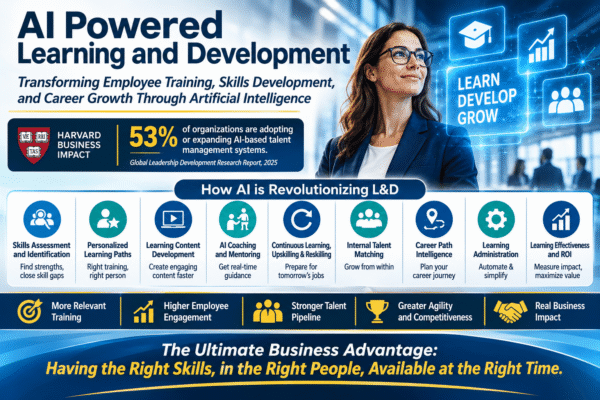
Harvard Business Impact’s 2025 Global Leadership Development Research Report found that 53% of surveyed organizations identified adopting or expanding AI-based talent management or internal mobility systems as a leading human capital project. Its research involved more than 1,100 L&D professionals and business leaders across more than 14 countries.
As organizations face rapidly changing business requirements, evolving technology, and increasing competition for skilled employees, Learning and Development (L&D) is becoming a strategic business priority. Traditional training programs, which often rely on standardized courses and periodic classroom instruction, are no longer sufficient to keep employees’ skills aligned with changing workforce demands. Artificial Intelligence (AI) is transforming Learning and Development by making employee training more personalized, accessible, measurable, and responsive to business needs. Rather than assigning the same training programs to everyone, AI can evaluate an employee’s existing skills, experience, performance, and career interests to recommend individualized learning paths. AI-powered L&D platforms can identify skill gaps, recommend training, create educational content, provide real-time coaching, monitor learning progress, and update employee skills profiles. They can also connect employees with internal job opportunities, promotions, mentorships, and development projects that support their career objectives. The result is a more continuous approach to workforce development in which employees acquire new capabilities while organizations build the talent they need for future growth.
| HR Workflow | AI Contribution | Agentic AI Contribution | Business Impact |
|---|---|---|---|
Skills Assessment | Analyzes employee skills, experience, assessments, and performance data to identify strengths and weaknesses. | Continuously updates employee skills profiles and identifies emerging development needs. | Better understanding of workforce capabilities and skills gaps. |
Personalized Learning Paths | Recommends training courses, educational content, and development activities based on individual needs and career goals. | Automatically builds, schedules, and adjusts individualized learning programs based on progress and changing requirements. | More relevant training and improved learning engagement. |
Learning Content Development | Creates training materials, quizzes, summaries, instructional videos, and interactive learning modules. | Develops and updates learning content using company policies, procedures, job requirements, and subject-matter expertise. | Faster content development and reduced administrative costs. |
AI Coaching and Mentoring | Provides employees with interactive coaching, feedback, explanations, and answers to questions. | Delivers ongoing coaching, practice exercises, reminders, and personalized development recommendations. | Improved employee performance and access to continuous coaching. |
Continuous Learning, Upskilling and Reskilling | Identifies changing skill requirements and recommends appropriate upskilling and reskilling opportunities. | Monitors changes in job requirements and proactively assigns development activities to prepare employees for future roles. | Greater workforce adaptability and reduced skills shortages. |
Internal Talent Matching | Matches employee capabilities and career interests with available positions, promotions, projects, and mentorships. | Identifies potential internal candidates and recommends development steps to prepare them for new opportunities. | Increased internal mobility and reduced external recruiting costs. |
Career Path Intelligence | Compares current employee capabilities with the skills required for future positions. | Creates individualized career maps and recommends milestones, learning activities, and development projects. | Improved career visibility, employee retention, and succession planning. |
Learning Administration | Automates course enrollment, scheduling, progress tracking, and reporting. | Enrolls employees, sends reminders, monitors completion, and adjusts learning schedules when necessary. | Reduced administrative workload and improved program completion. |
Learning Effectiveness and ROI | Analyzes assessments, completion rates, skill improvements, and performance results. | Produces ongoing workforce development reports and identifies programs requiring improvement. | Better training investments and measurable business results. |
Skills Assessment and Identification
AI-powered skills assessment analyzes employee skills, work experience, assessment results, and performance data to identify individual strengths, weaknesses, and competency gaps. It continuously updates employee skills profiles as employees gain experience, complete training, and develop new capabilities. By identifying existing skills and emerging development needs, organizations gain a clearer understanding of their workforce capabilities, uncover critical skills gaps, and make more informed decisions about employee development, training investments, succession planning, and internal mobility.
Personalized Learning Paths
One of the most valuable applications of AI in Learning and Development is the ability to create individualized learning experiences. Traditional training often provides the same material to employees regardless of their experience, existing knowledge, learning preferences, or career objectives. AI changes this approach by evaluating each employee’s capabilities and recommending training that addresses specific individual development needs. For example, an employee interested in becoming a department manager may need additional development in leadership, communication, conflict resolution, budgeting, and performance management. AI can identify these requirements, compare them with the employee’s current skills, and recommend a sequence of courses, coaching sessions, and practical assignments. As employees complete training and demonstrate new capabilities, AI can adjust their learning paths accordingly. Personalized learning can also improve participation by giving employees greater control over their development and connecting training to meaningful career opportunities.
Learning Content Development
Generative AI significantly reduces the time and resources required to develop employee training programs. Instead of creating every course manually, L&D professionals can provide AI with existing training materials, company policies, operating procedures, job descriptions, and subject-matter information. AI can use these resources to develop customized educational content. Examples include:
• Creating complete training courses from existing documents and presentations.
• Generating quizzes, knowledge checks, and certification assessments.
• Producing instructional videos and interactive learning exercises.
• Summarizing lengthy documents into short learning modules.
• Translating training materials into multiple languages.
• Developing realistic workplace simulations and role-playing exercises.
• Updating training materials when company policies or procedures change.
AI can also create different versions of the same training program for different departments, job levels, and employee experience levels. This allows organizations to develop and distribute relevant training more quickly while maintaining greater consistency across the workforce.
AI Coaching and Mentoring
Employees frequently encounter questions and challenges while performing their daily responsibilities. Traditionally, they must locate a training document, consult a supervisor, or wait for assistance from an experienced colleague. AI-powered learning assistants can provide immediate access to relevant information and guidance. Using company-approved policies, procedures, training materials, and organizational knowledge, AI chatbots and digital assistants can answer employee questions, explain processes, and recommend solutions. AI coaches can also simulate workplace situations, allowing employees to practice difficult conversations, customer interactions, sales presentations, management decisions, and problem-solving exercises. For example, a new manager could use an AI coach to practice conducting a performance review, addressing an employee conflict, or delivering constructive feedback before having the actual conversation. Harvard Business Impact’s 2025 research (1) identifies AI coaching as an opportunity to provide more consistent, accessible, and personalized development support. Its report also emphasizes the importance of combining AI with human coaching and judgment. The objective is to make learning part of everyday work rather than an activity that employees must schedule separately.
Continuous Learning, Upskilling, and Reskilling
The rapid development of technology is changing job responsibilities and the skills required to perform them. Organizations must continually evaluate their workforce capabilities and prepare employees for new business requirements. AI helps address this challenge by identifying emerging skills, evaluating current employee capabilities, and recommending appropriate upskilling and reskilling programs. For example, as an organization introduces automation and AI into its operations, employees may need additional training in data analysis, technology applications, critical thinking, problem-solving, and managing AI-assisted workflows. AI can identify which employees need these capabilities and recommend appropriate training before skill shortages negatively affect business performance. This creates a continuous learning environment in which employees regularly develop new capabilities rather than relying exclusively on occasional training events. The Conference Board’s 2026 research (3) highlights the urgency of this issue. Its survey of nearly 1,300 workers found that 55% regularly use AI, but only about one-third had participated in employer-provided AI training during the preceding six months. This illustrates the growing gap between technology adoption and workforce preparation.
Internal Talent Matching
Internal talent matching compares employee skills, experience, demonstrated capabilities, and career interests with available positions, promotions, special projects, and mentorship opportunities. For example, an employee working in customer service may have transferable communication, problem-solving, and relationship-management skills that could qualify them for a sales, account management, or supervisory position. AI can identify these adjacent skills, determine what additional capabilities are required, and recommend a personalized development plan to help the employee qualify.
Career Path Intelligence
Career path intelligence takes this process further by mapping potential career opportunities within the organization. Employees can see what skills are required for their next position, what training they need, and what development milestones they should achieve. Organizations benefit by developing existing employees for hard-to-fill positions, reducing recruiting costs, improving retention, and creating stronger succession pipelines. LinkedIn’s 2025 Workplace Learning Report (2) reinforces the relationship between career development and organizational performance. Its research found that organizations with mature career development programs were more confident in their ability to attract and retain qualified employees. It also found that 71% of L&D professionals were exploring, experimenting with, or integrating AI into their work.
Learning Administration
Research indicates that automated Learning Administration systems can significantly improve the efficiency and effectiveness of employee training programs by reducing manual administrative tasks associated with course enrollment, scheduling, progress monitoring, reminders, and reporting. The 2025 Training Industry Benchmark Report identified course bookings (44%) and course scheduling (36%) as continuing administrative challenges for training professionals, highlighting opportunities for automation. These findings demonstrate how AI-powered learning administration can streamline training operations, automatically enroll employees, coordinate schedules, identify overdue coursework, deliver personalized reminders, and provide real-time completion reports, reducing administrative workload while improving learner engagement, accountability, and training program completion.
Learning Effectiveness and ROI
Recent research findings support the use of AI-powered Learning Effectiveness and ROI analytics to evaluate assessments, course completion, knowledge retention, skill improvements, and changes in employee performance. By continuously analyzing workforce development data, AI can generate management reports, identify ineffective training programs, uncover skill gaps, recommend improvements, and connect learning investments to productivity, retention, operational efficiency, and financial performance—helping organizations make better training investments and achieve measurable business results.
Human Oversight
Human oversight remains important, particularly when decisions involve promotions, performance evaluations, employee opportunities, or sensitive personnel information. The objective is to automate routine administration and coordination while allowing HR professionals, managers, and employees to concentrate on development, coaching, and business results.
Conclusion
AI-powered Learning and Development represents a significant evolution in how organizations train, develop, and retain their employees. By combining AI-powered skills assessments, personalized learning paths, automated content development, real-time coaching, continuous learning, and internal talent matching, organizations can move beyond traditional training programs toward a more comprehensive and measurable approach to workforce development. Employees benefit from greater access to relevant training, clearer career opportunities, and individualized development plans. Managers gain better visibility into employee capabilities and development needs. HR and L&D professionals can spend less time on administrative activities and more time on strategic workforce planning, leadership development, and talent retention. Most importantly, organizations can develop the skills they need internally rather than relying exclusively on external recruiting to fill emerging talent requirements. The future of Learning and Development will not simply involve using AI to deliver training faster. It will involve using AI to continuously identify, develop, measure, and deploy employee capabilities in alignment with organizational objectives.
The ultimate business advantage is having the right skills, in the right people, available at the right time.
Research References
1. Harvard Business Impact (2025). Fast, Fluid, and Future-Focused: Building the Collective Intelligence of Humans and Machines. Global Leadership Development Research Report.
https://www.harvardbusiness.org/wp-content/uploads/2025/07/HBI_Report_2025-Global-Leadership-Development-Research-Report_Jun25.pdf
2. LinkedIn Learning (2025). Workplace Learning Report 2025: The Rise of Career Champions.
https://learning.linkedin.com/resources/workplace-learning-report
3. The Conference Board (2026). Most Organizations Are Preparing Workers for Today’s AI, Not Tomorrow’s Jobs.
https://www.conference-board.org/press/ai-skilling
4. Fouarge, D. et al. (2025). How AI-Augmented Training Improves Worker Productivity. IZA Discussion Paper No. 18224.
https://docs.iza.org/dp18224.pdf
5. University of Phoenix (2025). Generative AI Report: Learning Fuels Human + AI Collaboration.
https://www.phoenix.edu/content/dam/edu/media-center/doc/whitepapers/genai-report-final-remediated.pdf
6. Tang, C. et al. (2026). AI-Driven Adaptive Training for Utility Employees: A Three-Wave Cluster-Randomized Field Experiment on Cognitive-Load and Personalization-Fit Pathways. Frontiers in Psychology.
https://doi.org/10.3389/fpsyg.2026.1944626
7. Technology-Mediated Learning in the Workplace: Influence of Personalization (2026). Management Decision.
https://doi.org/10.1108/MD-04-2024-0825
8. The 2025 Training Industry Benchmark Report https://trainingmag.com/2025-training-industry-report/
Popular Posts
Measuring AI Contributions in Talent Management
September 17, 2026
AI Increases the Efficiency of Your HR Workflows
July 25, 2026
How AI Increases the Utility of Your Talent Pipeline
July 15, 2026
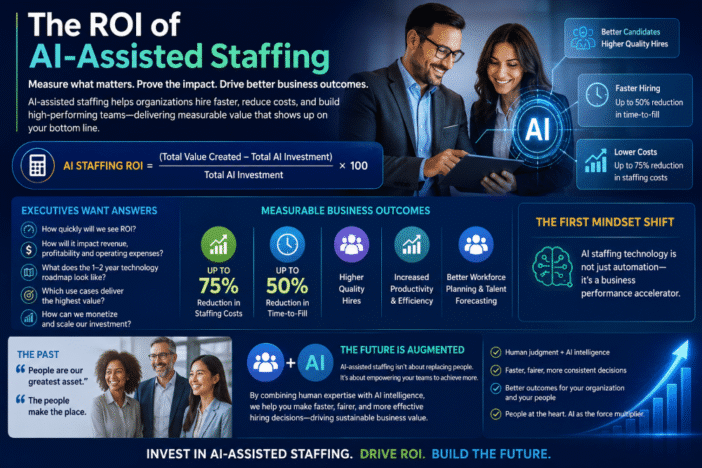
The ROI of AI-Assisted Staffing
May 20, 2026

Optimizing Talent Acquisition with AI
March 06, 2025

The History of Artificial Intelligence
January 13, 2025
Crafting the Future Workforce, One Hire at a Time
January 06, 2025
Boost Your Recruitment Strategy with AI-Assisted Staffing
September 24, 2024
Prevue Assessment: The Future of Talent Recruiting and Assessment Solutions
September 23, 2024
Leave a Reply