AI Increases the Efficiency of Your HR Workflows
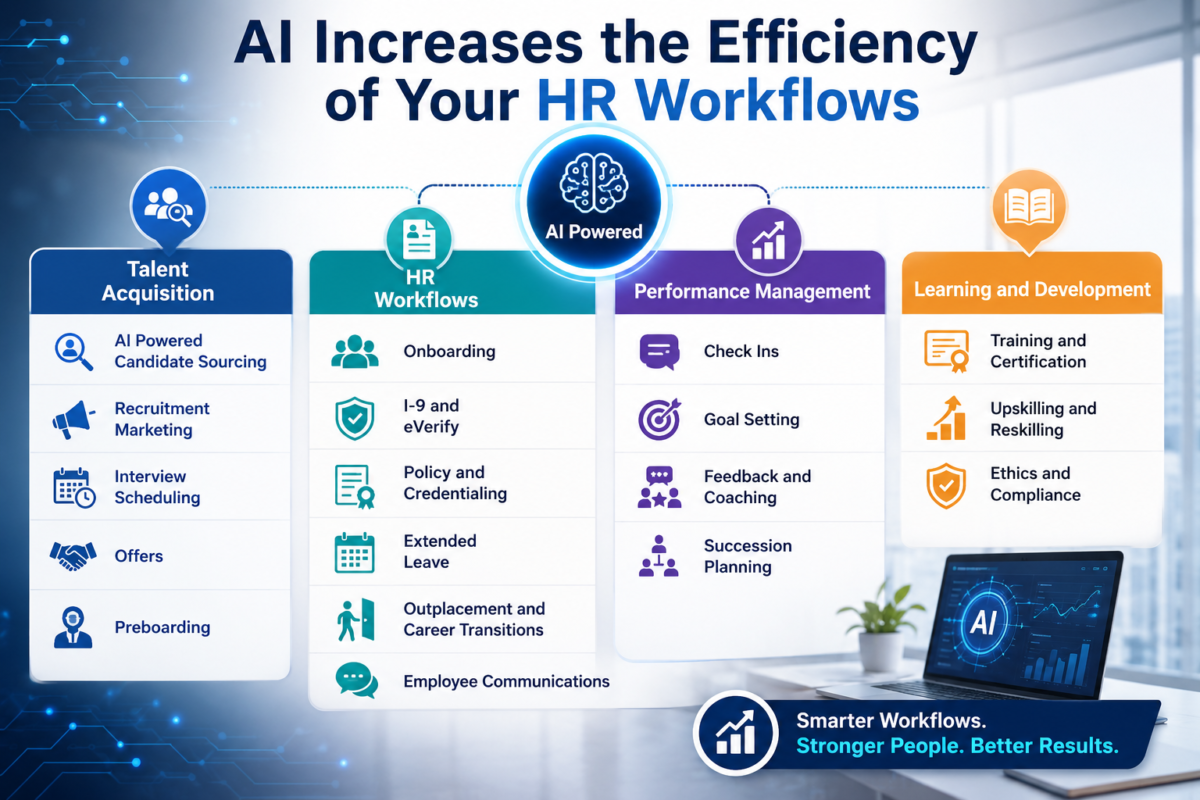
AI Powered Candidate Sourcing
AI assistance improves talent acquisition by automating repetitive administrative tasks and streamlining data analysis. By accelerating the front-end hiring process, AI enables recruiters to focus on building meaningful, human connections with top candidates. AI instantly parses resumes against job requirements and identifies applicants who meet baseline qualifications, saving hours of manual review. Machine learning and predictive analytics evaluate historical hiring data to identify candidates most likely to succeed in the specific role.
Recruitment Marketing
AI boosts recruitment marketing by automating outreach, writing inclusive job descriptions, and personalizing candidate communications. This allows teams to scale campaigns, target passive talent, and analyze engagement. AI quickly drafts job posts, career page copy, and targeted email campaigns. AI can also scan text for biased or exclusionary language to promote diversity. Instead of mass email blasts, AI analyzes candidate data and browsing history to deliver tailored job recommendations, interview follow-ups, and relevant content that keeps candidates engaged. AI can track interactions and measures campaign performance, providing actionable data on which channels and messages yield the highest quality hires.
Interview Scheduling
AI-powered tools automate interview scheduling and generate personalized outreach messages, preventing candidate drop-off and keeping talent pipelines moving quickly. AI eliminates back-and-forth emails. It syncs calendars in real-time across tools like Outlook and Google Workspace to automatically find matching availability. AI instantly adjusts for different time zones, and sends automated, personalized booking links, confirmations, and reminders to candidates. Recruiters are freed from manual logistics and can focus more on evaluating talent, while complex multi-interviewer panels are coordinated seamlessly.
Offers
AI assistance improves offers by analyzing talent market data to maximize acceptance rates. AI analyzes past interactions so an employer can draft more engaging, competitive, and targeted offer packages while minimizing errors.
Preboarding
AI streamlines the preboarding process by automating repetitive paperwork, personalizing role-specific learning paths, and providing 24/7 conversational assistance for routine questions. This reduces HR workloads and eliminates uncertainty for new hires before their first day. AI can auto-fill forms, verify documents and send sequenced, automated, tailored communications. New hires can ask an AI chatbot questions about company policies, benefits, or IT setup and receive immediate, reliable answers drawn from your organization’s knowledge base. AI tools gather real-time feedback and track early-stage engagement, alerting HR to potential preboarding bottlenecks before the employee even starts.
Onboarding
AI assistants drastically improve onboarding by automating administrative burdens, providing instant, 24/7 answers to new hire questions, and delivering hyper-personalized learning paths. Instead of drowning in generic handbooks, employees gain immediate clarity, which accelerates their time to peak productivity. AI automatically triggers IT system provisioning, routes approvals, and tracks required tax and compliance paperwork. AI chatbots serve as a centralized onboarding buddy, letting new hires ask policy questions (e.g., benefits, PTO) at any time without waiting for human HR responses. AI monitors engagement and sends automated nudges, ensuring no one gets stuck or falls behind in the onboarding journey.
I-9 and eVerify
The AI assistant streamlines the I-9 and E-Verify process by automating data entry, enforcing compliance rules, and catching human errors before they trigger government penalties or audit flags. It enables businesses to avoid minor clerical mistakes that lead to compliance issues during federal audits. AI validation tools auto-populate forms and immediately flag missing fields, logical discrepancies, or expired documents while data is being entered. AI can automatically trigger E-Verify case creation the moment Section 2 of the I-9 is completed, eliminating the need for duplicate data entry and manual tracking. Intelligent automated workflows guide employers and new hires through live-video document reviews and alternative DHS-compliant procedures, accelerating the onboarding of remote staff. AI algorithms continuously monitor document statuses, sending HR teams automated alerts for expiring work authorizations and upcoming reverification deadlines. AI platforms automatically log version histories, timestamps, and generate compliance dashboards, making it easier to gather required documentation during an ICE audit. It is important to note that the U.S. government (USCIS, ICE) is also actively using AI to process verifications. Federal agencies utilize machine learning and data analytics models to cross-reference I-9 submissions with databases like the DMV and SSA, as well as to spot name/date-of-birth variations that could trigger an automatic tentative non-confirmation.
Policy and Credentialing
The AI assistant transforms policy and credentialing by replacing slow, manual reviews with automated, data-driven workflows. Organizations leverage these tools to cut administrative onboarding times drastically, reduce human error, and maintain strict compliance with industry standards. AI automates primary source verification (PSV) and parallelizes payer enrollment, reducing timelines from up to 120 days down to 30. AI systems cross-reference credentials against federal databases and track expiration dates. This proactively flags upcoming issues to prevent compliance gaps. Natural Language Processing (NLP) extracts structured data from uploaded forms and maps it automatically into required fields, virtually eliminating redundant data entry. By cross-referencing provider data across systems and flagging inconsistencies in real time, AI prevents costly application rejections and claim denials. For organizations looking to deploy these systems responsibly, bodies like the NCCA AI Guidance Document emphasize a human-in-the-loop model, where qualified personnel validate AI-assisted decisions.
Extended Leave
The AI assistant improves extended leave by automating administrative tasks like compliance tracking, eligibility verification, and claims processing. This speeds up approval times and gives employees 24/7 access to information. It also allows HR teams to focus on empathetic, human-centric support. AI can systematically check leave requests against federal, state, and local laws (such as FMLA), reducing the risk of manual calculation errors. Instead of manually reviewing medical records, AI can extract critical details, flag missing information, and generate summaries for faster review. Conversational AI chatbots allow employees to ask questions about leave policies, benefits navigation, and pay adjustments, providing instant clarity outside of business hours. Specialized AI tools can generate personalized action plans for employees, outlining the necessary steps, required forms, and deadlines to take leave. Despite these improvements, organizations rely on human oversight for final decision-making.
Outplacement and Career Transitions
Outplacement is an employer-funded benefit that provides laid-off or terminated employees with professional support to transition to new jobs as a part of their severance package. These services—which include career coaching, resume writing, and interview prep—are typically provided by specialized firms. For the exiting employee, outplacement significantly cuts down the time it takes to find new employment. It provides emotional support, boosts confidence, and offers structured guidance to navigate a crowded job market effectively. AI assistance improves career transitions by translating your existing background and experience into new industry terminology, mapping out skill adjacencies, and reducing time-to-competence from years to weeks. It accelerates the pivot process by optimizing applications, simulating interviews, and managing repetitive learning tasks. AI quickly grasps specific industry jargon and decodes complex job requirements, helping you connect the dots between your past roles and a new sector. AI can synthesize labor market data to suggest realistic career options and build personalized, daily learning plans to help bridge knowledge gaps.
Employee Communications
AI dramatically improves employee communications by automating repetitive tasks, instantly personalizing messages for different audiences, and analyzing engagement data. It cuts through the “noise” to ensure workers receive relevant, targeted updates—from emergency alerts to daily policies—when and where they need them. Internal communication teams use AI to quickly draft memos, summarize lengthy reports, and optimize message formatting, freeing up time for high-level strategy. Instead of sending generic mass emails, AI segments workforces so that frontline, remote, and office employees receive communications tailored to their specific roles and locations. AI-powered enterprise chatbots instantly answer staff questions regarding HR policies, benefits, and company news, reducing repetitive queries for internal teams. AI tracks email open rates, click-through trends, and employee sentiment to continuously refine and measure communication effectiveness.
Check Ins
AI assistance improves employee check-ins by automating administrative burdens, surfacing real-time performance or sentiment data, and prompting tailored coaching conversations. Instead of relying on manual scheduling and generic feedback, managers can use data-driven insights to conduct more productive, personalized, and continuous 1-on-1s. AI tools (such as Hone) automatically schedule recurring check-ins and prep managers by consolidating past action items, project deadlines, and peer feedback before the meeting even starts. AI-powered pulse surveys and chatbots continuously collect qualitative and quantitative feedback. Natural Language Processing (NLP) immediately identifies drops in morale or highlights workplace friction, guiding managers to the exact topics needing discussion. Rather than evaluating work retroactively, AI systems compile objective data on task completion and goal progress. This shifts the focus from checking hours to evaluating actual achievements. Certain AI solutions listen in on check-in objectives or analyze employee goals to recommend real-time coaching tips, learning paths, or mental wellness resources tailored to individual needs. AI for employee engagement helps businesses collect feedback, identify patterns, and prompt appropriate actions.
Goal Setting
AI assistance improves goal setting by translating vague ideas into actionable milestones, testing plans for feasibility, and acting as a consistent accountability partner. It transforms traditional goal-setting by making the process highly interactive, personalized, and structured. AI can take poorly structured thoughts and rewrite them using frameworks like SMART or OKR, suggesting measurable metrics and clear timelines. AI roadmaps act like a reverse-engineering engine, taking a 5-year or 1-year objective and breaking it down into quarterly, monthly, and weekly action items. By asking AI to poke holes in your goals, you can identify potential blind spots, resource gaps, or unrealistic timelines before you begin. Recent studies show that AI chatbots improve goal progress by acting as an objective, judgment-free accountability buddy, which increases your perceived social accountability. Instead of relying on generic short-term “hacks,” AI can help design micro-habits based on your personal routines, schedule, and historical performance.
Feedback and Coaching
AI improves feedback and coaching by enabling real-time, personalized guidance and objective data analysis. It helps managers and coaches quickly synthesize performance data, detect communication patterns, and reduce bias, allowing them to focus on empathy, actionable development, and meaningful conversations. AI evaluates recorded interactions, transcripts, or data to provide instant feedback on tone, communication styles, and coaching effectiveness. AI reduces cognitive burden and bias by gathering feedback from multiple sources (e.g., self-reflections, peer reviews) to synthesize clear, actionable themes. AI acts as an accessible sounding board for individuals to practice difficult conversations, ask questions, and receive immediate coaching in the flow of work. It helps map specific feedback to individual career goals and skill gaps, turning constructive criticism into a structured roadmap. AI streamlines prep-work and documentation, saving valuable time and allowing human coaches to concentrate purely on the coaching relationship.
Succession Planning
AI improves succession planning by replacing subjective gut feelings with objective data. It uses skills analysis and predictive analytics to map employee capabilities against future leadership needs. AI uncovers hidden talent across all departments and identifies critical skills gaps before they disrupt business continuity. AI analyzes extensive performance data, learning agility, and soft skills to surface candidates who might otherwise be overlooked, minimizing human bias and promoting diversity. AI maps employees’ current competencies against the exact requirements of critical roles, scoring their “fit” and identifying areas for development. Algorithms forecast future leadership gaps, anticipate turnover, and spot single-successor dependencies, allowing for continuous, proactive pipeline management. AI automatically recommends tailored learning programs, stretch assignments, and mentoring programs to prepare high-potential employees for advancement.
Training and Certification
AI dynamically adjusts training material based on the employee’s specific role, seniority, and learning pace. AI assistance revolutionizes training and certification by hyper-personalizing the learning experience, accelerating content creation, and automating assessments. It shifts corporate education from static lectures to interactive, adaptable environments, which dramatically improves both knowledge retention and program completion rates. AI assesses a learner’s baseline skills, identifies knowledge gaps, and dynamically adapts the curriculum’s difficulty in real-time. AI models can act as virtual role-play allowing users to practice their responses safely. Virtual AI coaches offer 24/7 support to answer specific questions, clarify complex concepts, and provide instant feedback on practice exercises. Subject Matter Experts (SMEs) can use AI authoring tools to drastically cut down the time it takes to build, update, or localize training materials. AI evaluates performance data and complex assignments, providing rapid, objective feedback. AI-powered proctoring uses biometrics and behavioral analysis to monitor exams securely from anywhere in the world. AI helps generate large, randomized question banks, preventing memorization and maintaining strong exam security. Upon passing, AI-enhanced systems streamline the issuance of verifiable certifications that learners can easily share across platforms like LinkedIn, Apple Wallet, or Google Wallet.
Upskilling and Reskilling
The AI assistant accelerates upskilling and reskilling by delivering hyper-personalized learning paths, real-time contextual coaching, and automated skill-gap analysis. Instead of generalized courses, workers receive bite-sized content tailored to their learning pace, enabling them to acquire new capabilities directly within their daily workflows. AI assesses a learner’s baseline and dynamically adapts the curriculum, focusing on areas of weakness while skipping already mastered concepts. Assistants (like ChatGPT) allow employees to ask questions about complex topics on-demand, transforming learning from a static event into a continuous, interactive conversation. Organizations can use AI to identify exact skill adjacencies, predicting which employees are best suited for emerging roles and closing execution gaps faster than traditional training methods. AI-driven simulations and interactive coaching provide a judgment-free zone for workers to practice new tasks (such as client negotiations or coding) before applying them in the real world.
Ethics and Compliance
AI improves ethics and compliance by shifting programs from reactive to proactive. It continuously monitors transactions for misconduct, automates policy updates, and intelligently identifies potential conflicts of interest. AI also enhances compliance training by tailoring it to individual needs and improving whistleblower triage. AI Instantly scans massive datasets to identify behavioral anomalies, spend patterns, or anomalies that deviate from historical norms. AI streamlines the screening of third parties and transactions against changing global regulations to reduce human error. AI categorizes whistleblower reports by risk and severity, speeding up internal investigations.
Popular Posts
Measuring AI Contributions in Talent Management
September 17, 2026
How AI Increases the Utility of Your Talent Pipeline
July 15, 2026
The ROI of AI-Assisted Staffing
May 20, 2026
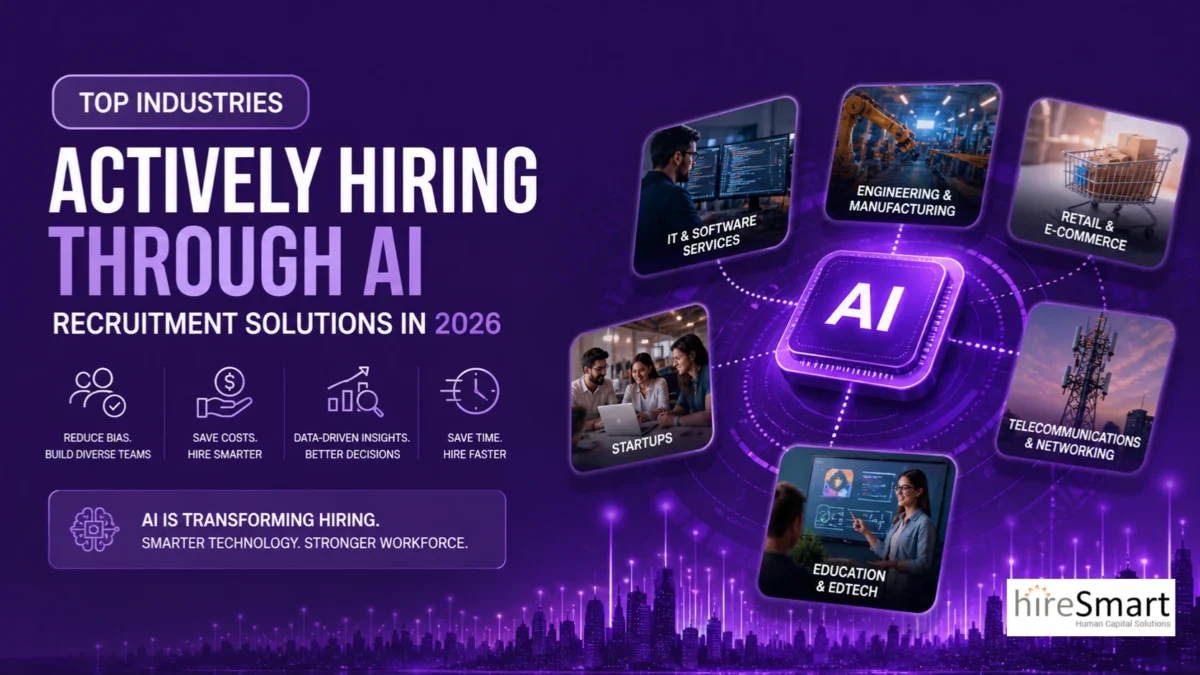

Optimizing Talent Acquisition with AI
March 06, 2025

The History of Artificial Intelligence
January 13, 2025
Crafting the Future Workforce, One Hire at a Time
January 06, 2025
Boost Your Recruitment Strategy with AI-Assisted Staffing
September 24, 2024
Prevue Assessment: The Future of Talent Recruiting and Assessment Solutions
September 23, 2024

Common Qualities of Low Performing Managers
June 23, 2024
Leave a Reply